
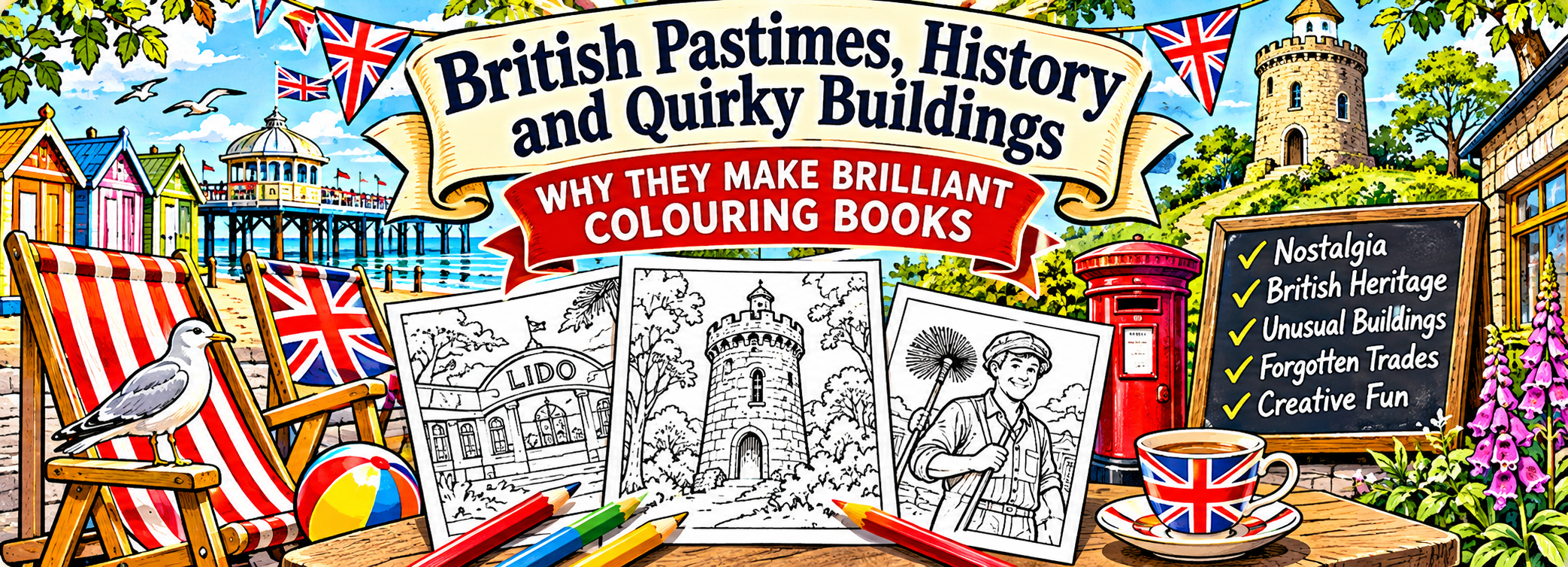
There is something rather special about British history. From the seaside lidos and village high streets of the 1950s to the wonderfully eccentric follies hidden in the countryside, Britain is full of places, traditions and everyday activities that deserve to be remembered.
And what better way to bring them back to life than through colouring?
British-themed colouring books offer something a little different from the usual flowers, mandalas and generic patterns. They combine creativity with nostalgia, history, discovery and a healthy appreciation for some of the wonderfully quirky things that make Britain what it is.
Whether you remember the places yourself, have an interest in British heritage or simply enjoy a good colouring session, these books offer far more than something to fill in with coloured pencils.
So, why are British pastimes, historic buildings and traditional ways of life such brilliant subjects for colouring books?
Let’s take a look.
1. British Nostalgia: Bringing Forgotten Pastimes Back to Life
Britain has changed enormously over the last century. Shopping habits, entertainment, work, transport and leisure activities are almost unrecognisable compared with everyday life 50, 60 or 70 years ago.
Yet many of those memories remain remarkably vivid.
Think about the traditional British pastimes that once filled people’s weekends and evenings:
- Visiting the local outdoor swimming baths.
- Spending summer holidays at the seaside.
- Going to the village fete or country fair.
- Playing bowls on the local green.
- Taking a trip to the amusement arcade.
- Enjoying fish and chips wrapped in paper.
- Visiting traditional markets and independent shops.
- Spending Sunday afternoons in the garden.
- Watching steam trains arrive at the station.
- Enjoying a traditional British pub.
These are the little details that make social history so interesting.
A colouring book featuring familiar British scenes allows people to reconnect with places, activities and experiences that may have been part of their childhood. For younger generations, it offers an opportunity to discover a version of Britain they might only have heard about from parents and grandparents.
It’s also a lovely conversation starter. A picture of an old-fashioned seaside promenade can easily lead to someone remembering their first holiday in Blackpool, Brighton or Bournemouth.
2. Why Traditional British Buildings Make Brilliant Colouring Subjects
British architecture is wonderfully varied. You don’t have to travel far to find buildings with unusual shapes, fascinating details and stories behind them.
From grand country houses to tiny follies tucked away in woodland, our built heritage offers an almost endless supply of inspiration.
Some of the most interesting subjects include:
- Victorian railway stations with elaborate ironwork.
- Traditional thatched cottages.
- Medieval castles and ruined abbeys.
- Old village pubs and coaching inns.
- Victorian seaside shelters.
- Windmills and watermills.
- Gothic towers and architectural follies.
- Traditional bandstands.
- Historic market halls.
- Ornate garden temples.
What makes these buildings particularly good for colouring is their detail.
Brickwork, windows, roof tiles, decorative stonework, archways, gates and surrounding gardens all provide opportunities to experiment with different colours and techniques.
Unlike some repetitive colouring patterns, every building presents a different challenge. You can spend time carefully colouring architectural details or take a more relaxed approach and concentrate on the larger shapes.
There is also an educational element. You might discover a building you have never heard of, look up its history and find yourself planning a visit.
3. The Wonderful World of British Follies
If there is one subject that perfectly captures Britain’s love of the unusual, it’s the architectural folly.
A folly is generally a decorative building constructed primarily for visual appeal rather than practical use. Some resemble ruined castles, others look like miniature temples, Gothic towers, mock fortifications or elaborate garden ornaments.
And Britain has plenty of them.
These buildings are often hidden away in country estates, landscaped gardens and historic parks. Some were built hundreds of years ago, while others are relatively modern additions to the British landscape.
They are also fantastic subjects for colouring.
Imagine bringing these architectural oddities to life:
- Broadway Tower in Worcestershire.
- Beckford’s Tower in Bath.
- The Dunmore Pineapple in Scotland.
- Wainhouse Tower in Halifax.
- Hadlow Tower in Kent.
- The Temple of the Winds in Northern Ireland.
- Rushton Triangular Lodge in Northamptonshire.
- The Pepperpot in Brighton.
Each has its own distinctive character, shape and architectural features.
For anyone who enjoys colouring buildings, British follies offer something a little more unusual than the traditional castle or stately home.
Our British Follies Colouring Book celebrates these extraordinary structures, bringing together 50 wonderfully interesting British follies in one collection.
It’s ideal for anyone who enjoys British architecture, unusual landmarks, history and discovering the stranger side of our built heritage.
You can find the book here:
4. British Seaside Culture: More Than Just Sandcastles
Few things are more deeply embedded in British nostalgia than a traditional seaside holiday.
For generations, a trip to the coast was one of the highlights of the summer. Families packed their buckets and spades, bought sticks of rock, enjoyed donkey rides and spent hours exploring the promenade.
And then there were the lidos.
Outdoor swimming pools became an important part of British leisure culture, particularly during the 1920s and 1930s. Many featured striking Art Deco architecture, geometric shapes, diving boards and beautifully designed poolside buildings.
Today, some have disappeared, while others have been restored and remain much-loved community attractions.
They make wonderful colouring subjects because there is so much variety in the scenes:
- Classic outdoor swimming pools.
- Art Deco pool buildings.
- Traditional beach huts.
- Seaside promenades.
- Victorian piers.
- Punch and Judy shows.
- Traditional deckchairs and parasols.
- Ice cream kiosks.
- Vintage amusement arcades.
- Seaside cafés and fish and chip shops.
There is a real sense of personality in these scenes. They capture a particular period of British life without needing complicated explanations.
Our British Lidos: 50 Wonderful Images to Colour celebrates these much-loved swimming pools and their place in British leisure history.
Whether you remember swimming in an outdoor pool yourself or simply appreciate the architecture, it’s a lovely collection of distinctly British scenes.
Explore the book here:
5. Forgotten British Trades: A Glimpse Into Everyday Life
Not all British history is about grand buildings, famous landmarks or royal events.
Some of the most fascinating stories come from ordinary working people.
Before supermarkets, online shopping and modern convenience services, British towns and villages relied on an enormous range of traditional trades.
Many have disappeared or become incredibly rare.
Think about the people who once provided everyday services in local communities:
- The chimney sweep.
- The milkman.
- The lamplighter.
- The rag-and-bone man.
- The blacksmith.
- The cooper.
- The wheelwright.
- The travelling knife grinder.
- The traditional cobbler.
- The village farrier.
These trades were an essential part of everyday British life.
Their tools, clothing, workshops, vehicles and working environments provide fantastic visual inspiration. They also tell us a great deal about how communities functioned before modern technology changed almost everything.
A picture of a traditional blacksmith’s workshop, for example, can include an anvil, forge, tools, horseshoes and a working environment full of interesting details.
Our Endangered and Extinct Trades from Bygone Years colouring book celebrates these forgotten occupations and the people who kept Britain’s towns and villages running.
It’s a great way to explore social history while enjoying something creative.
Discover the collection here:
6. Why History-Themed Colouring Books Appeal to All Ages
One of the biggest advantages of British-themed colouring books is their broad appeal.
You don’t need to be an expert in history, architecture or British culture to enjoy them.
Different subjects appeal to different people, but there is something for almost everyone.
For adults and older generations
Nostalgic colouring books can bring back memories of childhood, family holidays, traditional high streets and familiar places that have changed over time.
They also offer a relaxing creative activity that doesn’t require specialist knowledge or equipment.
For younger adults
British heritage books provide an accessible way to discover the country’s history, architecture and traditions.
They can also introduce subjects that might otherwise seem rather distant or academic.
For children and families
Colouring together can encourage conversations about how people lived, worked and spent their leisure time in previous generations.
A picture of a Victorian railway station or an old-fashioned seaside holiday can become a starting point for learning something new.
For creative hobbyists
Buildings, landscapes, vehicles and traditional scenes offer plenty of opportunities to experiment with colour combinations, pencils, pens and different colouring techniques.
The beauty of a well-designed colouring book is that there is no single correct way to complete a picture.
7. What Makes a Good British-Themed Colouring Book?
Not all colouring books are created equal.
A good British-themed colouring book should offer more than a collection of generic illustrations with a British title on the cover.
There are several things worth looking for before buying.
Authentic British subjects
The illustrations should reflect recognisable British places, buildings, traditions and everyday life.
Details matter. A traditional British pub should look like a British pub, not an American bar. A British seaside scene should capture the character of our coastline.
Interesting and varied illustrations
A good collection should offer a mixture of subjects and compositions.
For example, a book about British heritage might include buildings, street scenes, vehicles, landscapes, working environments and everyday activities.
Variety keeps the experience interesting and gives you something different to look forward to on every page.
Clear, well-defined outlines
Colouring illustrations should have clean black outlines, clearly defined shapes and enough open space to make colouring enjoyable.
Overly complicated designs can become frustrating, particularly when there is little room to work with different colours.
Good print quality
Paper quality and printing make a real difference.
Look for crisp illustrations, clean lines and pages that are comfortable to colour. If you prefer using felt-tip pens or markers, check whether the paper is suitable and consider placing a spare sheet behind the page.
A subject worth discovering
Perhaps most importantly, a good colouring book should make you curious.
You might start with a picture of an unusual tower and end up researching its history. You might recognise a traditional trade and remember someone who did that job when you were younger.
That’s part of the enjoyment.
8. How to Get More From Your British History Colouring Books
You don’t need expensive equipment or complicated techniques to enjoy colouring.
A few simple steps can make the experience even more rewarding.
Step 1: Choose a subject you enjoy
Start with something that interests you.
It could be British architecture, nostalgic seaside holidays, traditional trades or historic landmarks.
Step 2: Gather your colouring materials
You can get started with a basic selection of coloured pencils.
For more variety, consider adding:
- A selection of warm and cool coloured pencils.
- Fine-liner pens for small details.
- Blending pencils for softer transitions.
- A pencil sharpener.
- An eraser.
- A spare sheet of paper to protect the page underneath.
Step 3: Think about the period
If you’re colouring a Victorian building, a 1950s seaside scene or a traditional blacksmith’s workshop, consider the colours and materials associated with that period.
A little historical research can make your finished picture feel more authentic.
Step 4: Work from larger areas to smaller details
Start with the larger sections of the illustration before moving on to windows, brickwork, decorative details and smaller objects.
This makes it easier to build a balanced colour scheme.
Step 5: Don’t be afraid to experiment
There are no rules saying that a building must be coloured exactly as it appears in real life.
You can recreate authentic colours or let your imagination take over.
Step 6: Learn something along the way
If an illustration features a building, trade or landmark you don’t recognise, look it up.
You might discover somewhere worth visiting or a fascinating piece of British history you never knew existed.
9. Why British-Themed Colouring Books Make Thoughtful Gifts
Finding a gift that feels personal can be surprisingly difficult.
A British-themed colouring book offers something a little different from the usual gifts. It’s a physical product that encourages people to slow down, get creative and enjoy a subject they already love.
They can make particularly good gifts for:
- Parents and grandparents who enjoy nostalgia.
- Anyone interested in British history.
- Architecture and heritage enthusiasts.
- People who enjoy visiting historic places.
- Creative hobbyists.
- Anyone who appreciates traditional British culture.
- Those looking for a thoughtful birthday or Christmas present.
They can also be a lovely way to share memories between generations.
A grandparent might recognise a familiar seaside scene, while a younger family member discovers something about how holidays used to be enjoyed.
And unlike many gifts that are quickly forgotten, a colouring book provides hours of entertainment.
10. Discover More British-Themed Colouring Books
At British Colouring Books, we’re passionate about creating colouring books that celebrate the places, people, traditions and subjects that make Britain interesting.
Our collections are designed around recognisable British themes, with carefully selected subjects and illustrations that offer something different from the standard colouring book.
Whether you’re interested in forgotten trades, unusual architecture or traditional seaside culture, there’s plenty to explore.
Three collections worth discovering are:
British Follies Colouring Book
Explore 50 unusual and fascinating British architectural structures.
British Lidos: 50 Wonderful Images to Colour
Celebrate the outdoor swimming pools and seaside leisure attractions that have played such an important part in British life.
Endangered and Extinct Trades from Bygone Years
Discover the traditional occupations and forgotten working lives that helped shape Britain’s communities.
You can explore more of our collections at British Colouring Books.
Frequently Asked Questions
What are British-themed colouring books?
British-themed colouring books feature illustrations inspired by British history, culture, architecture, traditions, landmarks and everyday life. Subjects can include historic buildings, seaside holidays, traditional trades, transport and nostalgic scenes.
Are colouring books suitable for adults?
Absolutely. Adult colouring books are popular with people of all ages. They provide an enjoyable creative hobby, encourage concentration and offer an opportunity to take a break from screens and everyday distractions.
What are the best colouring books for people interested in British history?
Look for books featuring traditional British architecture, historic landmarks, forgotten trades, vintage transport and nostalgic scenes. These subjects combine creative enjoyment with opportunities to learn about Britain’s past.
What is a British architectural folly?
A folly is an unusual decorative building, generally constructed for visual appeal rather than practical use. British examples include towers, mock castles, miniature temples and eccentric garden structures.
Why are nostalgic colouring books so popular?
Nostalgic colouring books feature familiar places, activities and objects that remind people of earlier periods in their lives. They can bring back memories, encourage conversations and offer a relaxing creative activity.
Are British colouring books good gifts?
Yes. They make thoughtful gifts for people interested in history, architecture, British heritage, nostalgia and creative hobbies. They are suitable for birthdays, Christmas and other special occasions.
Where can I buy British-themed colouring books in the UK?
You can explore a range of British-themed colouring books at British Colouring Books. Our collections include historic trades, British follies, seaside memories, lidos, iconic cars, motorbikes and much more.
Visit https://britishcolouringbooks.co.uk/ to discover the collection.
A Little Bit of Britain, One Colour at a Time
Britain has an extraordinary collection of stories, traditions, buildings and everyday experiences worth celebrating.
From the eccentric folly hidden in a country garden to the outdoor swimming pool where generations spent their summer holidays, these subjects capture something that makes our history uniquely interesting.
Colouring books give us a simple way to revisit those memories, discover something new and enjoy a little creativity along the way.
And that’s exactly what British Colouring Books is all about.
Explore. Remember. Colour.
Rob Budd
Author, British Colouring Books